


Nashville has changed a lot over the last decade. While it used to be a somewhat quiet Southern town known almost exclusively for country music, it is now a booming metropolitan hub. For active adults looking to retire, this shift brings the best of both worlds: you get the vibrant energy, arts scene, and world-class dining of a major city, combined with the tax benefits and hospitality Tennessee is famous for.
It’s not just young professionals moving to Nashville; we are seeing a huge influx of retirees seeking a better quality of life. The appeal goes beyond the honky-tonks on Broadway. It’s about a favorable cost of living relative to coastal cities, access to top-tier healthcare like Vanderbilt, and diverse housing options. Whether you are looking for a quiet cottage or a resort-style campus, the area has evolved to meet the demand.
Why Choose Nashville for Retirement?
If you are wondering what drives people to pack up and head to Middle Tennessee, the conversation almost always starts with finances. Tennessee is incredibly tax-friendly for retirees. There is no state income tax on wages or salaries, and importantly, there is no state tax on Social Security benefits. Furthermore, the Hall Income Tax, which used to tax interest and dividends, has been fully repealed. This can mean significant annual savings for those living on fixed incomes or investment portfolios.
Beyond the ledger, the lifestyle here is a major draw. We enjoy four distinct seasons, but without the brutal, long winters found in the North. You might see a dusting of snow once or twice a year, but it generally melts within a day or two. Summers can be humid, but spring and fall are absolutely spectacular, allowing for a long season of golf, gardening, and outdoor festivals.
Healthcare is another pillar of Nashville’s appeal. With Vanderbilt University Medical Center anchoring the region, along with Ascension Saint Thomas and TriStar systems, you have access to some of the best medical care in the country. Finally, the central location is unbeatable. With the recent expansion of BNA Airport, hopping on a flight to visit grandkids or travel internationally is easier than ever.
Top 55+ and Active Adult Communities in Nashville
When we talk about retirement communities in Nashville, it is important to clarify the geography. Most of the large-scale, amenity-rich developments are not in downtown Nashville itself. Instead, they are located in the thriving suburbs like Mt. Juliet, Spring Hill, and Murfreesboro. This setup offers residents a quieter, lower-traffic daily life while keeping the city’s cultural amenities just a short drive away.
It is also helpful to distinguish between "resale-only" communities, which are established neighborhoods where you buy from a current owner, and "new construction" sites where you can build from the ground up.
Del Webb Lake Providence (Mt. Juliet)
If you ask a local agent about the gold standard for active adult living in the area, Del Webb Lake Providence is usually the first name that comes up. Located in Mt. Juliet, roughly 20 to 25 minutes east of the airport, this community is fully established. Since it is resale-only, you don’t have to deal with construction noise, and the social scene is already vibrant and well-oiled.
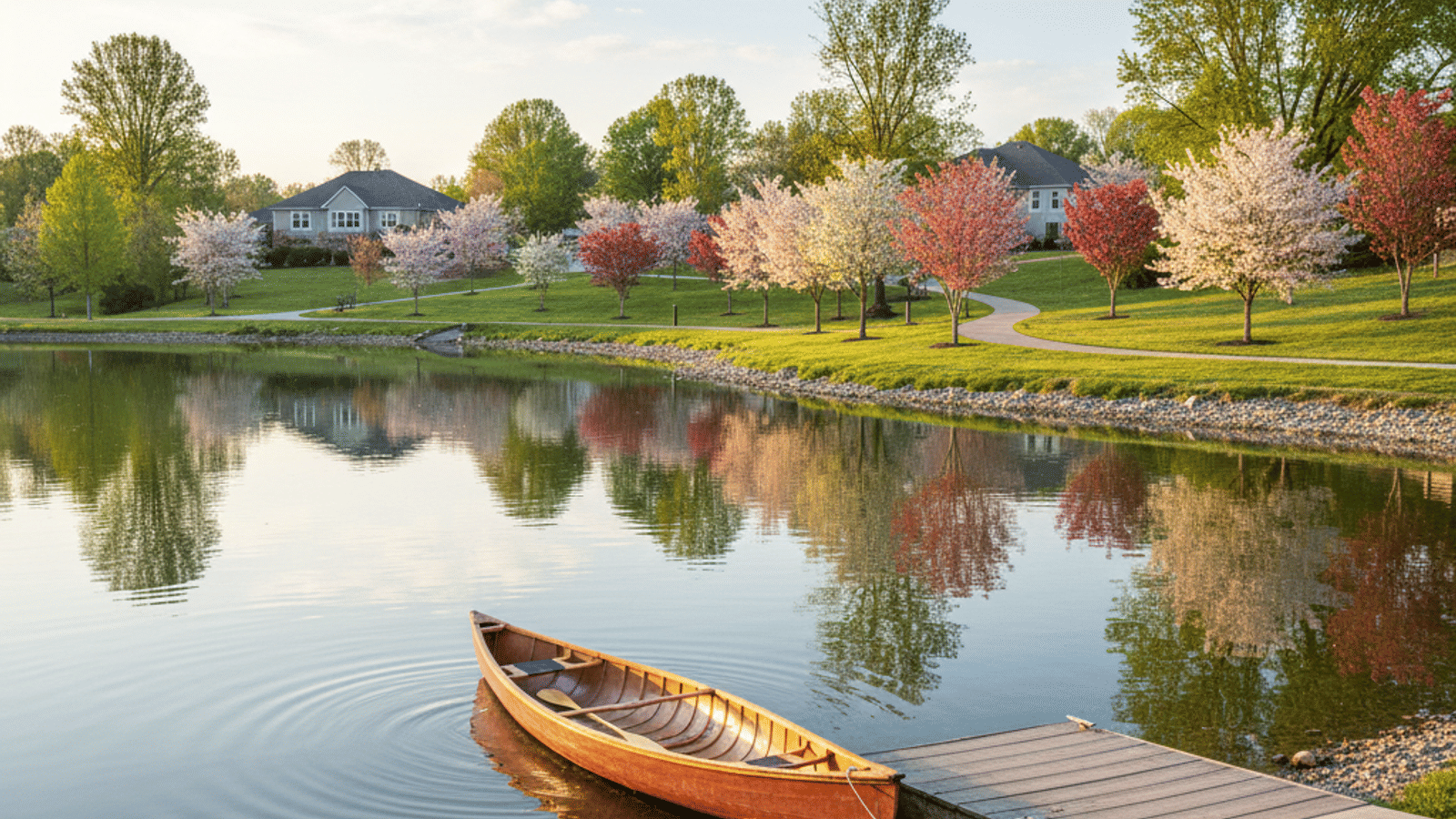
The lifestyle here revolves around the water. The community features a 15-acre fishing lake stocked for residents, complete with a canoe and kayak launch. The clubhouse is massive—covering about 24,000 square feet—and houses indoor and outdoor pools, a fitness center, and space for dozens of clubs. It sits right near the Providence Marketplace, so you have easy access to grocery stores, restaurants, and shopping without venturing far.
Regarding costs, homes here have appreciated significantly. You can generally expect prices to range from the high $300,000s to the mid $700,000s, though homes with direct lake views can command premiums pushing up toward $1 million. HOA fees hover around $280–$300 per month, which is competitive considering the scale of the amenities.
Del Webb Southern Springs (Spring Hill)
For those who prefer a slightly more modern aesthetic, Southern Springs in Spring Hill is a fantastic option south of Nashville. While mostly resale now, this community is newer than Lake Providence, and the architecture reflects that with more open floor plans and modern finishes. The vibe here is energetic; you will see a heavy focus on pickleball and active social clubs.
Spring Hill itself is a unique blend of history and rapid suburban growth. It is a bit further from the airport than Mt. Juliet, but it offers a distinct charm and easy access to Franklin. The amenity center here is a multi-million dollar complex featuring a ballroom and resort-style pool. Prices here typically run from the low $500,000s to the mid $800,000s, with monthly HOA fees similar to Lake Providence, roughly $275–$300.
Del Webb Southern Harmony (Murfreesboro)
If your heart is set on new construction and you want to pick your own lot and finishes, Southern Harmony is the one to watch. Located in Murfreesboro, southeast of Nashville, this is the newest major entrant to the market.
Murfreesboro generally offers a more affordable overall cost of living compared to the Franklin area, making this an attractive value proposition. Because it is in the active building phase, buyers have the chance to customize their homes to fit their specific needs. Prices are currently ranging from the $400,000s to the $800,000s, depending heavily on the floor plan and upgrades you select.
Other Notable Communities Near Nashville
While the large resort-style communities get the most attention, there are excellent smaller or niche options worth considering depending on your lifestyle goals.
- Parkhaven (Hermitage): This is arguably the closest 55+ community to downtown Nashville. It has a unique "agri-hood" focus, centered around community gardens and nature. The homes are beautifully designed with master-down plans, typically priced in the $500,000s to $700,000s.
- The Cloister at St. Henry (Nashville/Belle Meade): This is an older, established community located in a prime area near Belle Meade. It consists of duplex cottages and is known for being very quiet and private. Inventory is rare here, but older units can sometimes be found in the $300,000s to $400,000s.
- Reid Hill Commons (Franklin): For those wanting the upscale address of Franklin in a smaller, intimate setting, this is a great choice. It is difficult to get into due to low inventory, but it offers luxury living on a smaller scale.
Cost of Retirement in the Nashville Area
Let's have a realistic conversation about the budget. Years ago, people moved here because real estate was incredibly cheap. Today, the cost of living in Nashville has risen, and while it is still a bargain compared to California or the Northeast, "cheap" isn't the right word anymore. You should expect to pay near national averages—or higher—for prime locations in safe, amenity-rich neighborhoods.
Housing will be your biggest line item. In the Nashville metro area, the median home price often hovers in the $450K–$500K range, though this varies wildly by suburb. In 55+ communities, you are also paying for the lifestyle, which keeps values stable.
Don't let the HOA fees scare you. In these communities, monthly fees of $250–$400 are standard, but they often cover essential services like lawn care, exterior maintenance, security monitoring, and access to pools and gyms. When you do the math on what you would pay for those services individually, the fee often balances out.
It is also worth noting that while we have no income tax, Tennessee does have a high sales tax—roughly 9.25% when you combine state and local rates. It’s a consumption tax model: you pay on what you spend, not what you earn. Additionally, for low-income seniors, there are Property Tax Relief Programs available that can help offset annual costs.
Location Guide: Franklin vs. Mt. Juliet vs. Murfreesboro
Choosing the right community is often less about the house and more about the town it sits in. The suburbs surrounding Nashville have very different personalities.
- Franklin & Brentwood: This is the upscale choice. You’ll find historic charm, luxury boutiques, and high-end dining. It feels sophisticated and polished. While there are fewer dedicated 55+ communities here, many retirees flock to the area for the quality of life.
- Mt. Juliet: Known as the "Gateway to the Appalachians," this area sits between two lakes. It is perfect if you love fishing or boating. It is also incredibly convenient for shopping and offers the easiest commute to the airport.
- Murfreesboro: This is a college town (home to Middle Tennessee State University), which gives it a youthful energy. It is generally more affordable than Franklin and has all the big-box amenities you need, though the commute into Nashville can be traffic-heavy during rush hour.
Healthcare and Medical Amenities
For many retirees, proximity to quality healthcare is a non-negotiable factor. Nashville’s reputation as the healthcare capital of the U.S. is well-earned. Vanderbilt University Medical Center is a nationally ranked research hospital that attracts patients from all over the region for complex procedures and specialized care.
However, you don’t always need to drive downtown for excellent treatment. The suburban infrastructure is robust. Williamson Medical Center in Franklin is top-tier, and TriStar Summit serves the Mt. Juliet and Hermitage areas effectively. These networks have a high concentration of geriatric specialists and cardiac care centers, ensuring that as you age, the support system you need is right in your backyard.
Frequently Asked Questions
Is Nashville a tax-friendly state for retirees?
Yes, it is very friendly. Tennessee has no state income tax on wages and does not tax Social Security benefits or pension income. The trade-off is a higher sales tax (around 9.25%), but for most retirees living on fixed income or investments, the math works out in their favor.
What is the average cost of a home in a Nashville 55+ community?
While prices vary by location and luxury level, you should generally budget between $400,000 and $600,000 for a typical home in a popular community like Del Webb. Premium lots with views or custom finishes in newer developments can easily push prices into the $700,000s or higher.
How is the traffic in Nashville for retirees?
Traffic has increased significantly with the city's growth and can be heavy during rush hours. However, most retirement communities are designed to be self-contained with shopping and medical needs nearby, so you can easily plan your day to avoid peak commuter times.
Does it snow in Nashville?
We do get snow, but it is usually mild. You might see a few inches once or twice a winter, but it rarely stays on the ground for long. You get the beauty of a four-season climate without the burden of months of shoveling or sub-zero temperatures.
Are there active adult communities within Nashville city limits?
There are very few large-scale active adult communities inside the actual city limits of Nashville. Most of the major communities with clubhouses and resort amenities are located in the surrounding suburbs like Mt. Juliet, Spring Hill, and Franklin, where there is more land available.