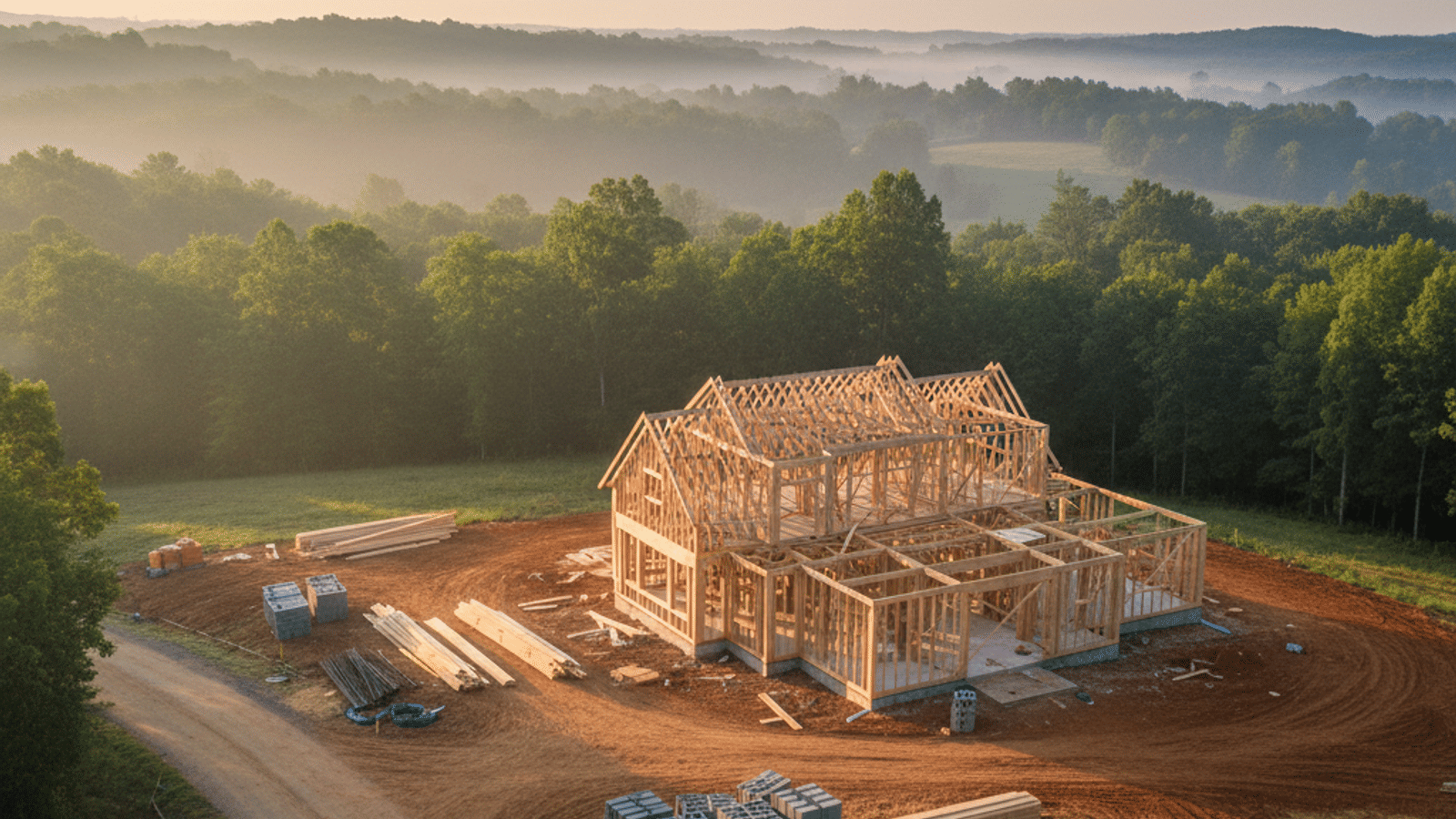
If you’ve been scrolling through listings in Nashville lately, you’ve probably noticed a trend. Inventory is tight, prices are holding strong, and a lot of the available homes are older ranches that need a massive renovation to feel current. For many buyers moving to Middle Tennessee or looking to upgrade, the math starts to point in a different direction: building from scratch.
As of early 2026, building a custom home is one of the best ways to get exactly what you want in the Greater Nashville area without fighting a bidding war for a house you only mostly like. Whether you are eyeing a teardown in 12 South or a few acres out in Williamson County, building offers total customization in a market where inventory is aging.
However, I always tell my clients to pour a fresh cup of coffee and settle in before we make the leap. Building a custom home is a complex process. It is not a quick fix for a housing shortage; it is a marathon that usually takes 12 months or more. If you are ready to navigate the zoning, the mud, and the limestone, here is how the process actually works right now.
Cost to Build a House in Nashville (2026 Estimates)
Let's get right to the number everyone asks about first. "How much per square foot?" is the most common question I hear, but the answer varies wildly depending on two main factors: your finishes and your land's terrain. Nashville isn’t flat like Florida; we have hills and ridges, and building on a slope costs significantly more than building on a slab in a flat field.
When budgeting, you need to separate your "Hard Costs" from your "Soft Costs." Hard costs are what you can touch—lumber, concrete, labor, and drywall. Soft costs are the invisible expenses that can sneak up on you, such as permits, architectural design fees, and the interest on your construction loan.
One specific area where buyers get in trouble is the "allowances" section of the builder's contract. A builder might quote you a price based on an allowance of $3 per square foot for flooring. That might get you basic LVP (Luxury Vinyl Plank), but if you have your heart set on wide-plank white oak, the price of the home just went up. Ensure your allowances reflect 2026 material prices so you aren't writing checks for overages every week.
Here is a realistic look at what you can expect to pay for construction in the current market. Keep in mind, these figures are for the build only and exclude the cost of the land.
- Value/Standard Build: $160–$220 per sq. ft. This usually gets you a spec-level home with basic finishes, standard appliances, and assumes a relatively flat lot.
- Mid-Range/Semi-Custom: $250–$450 per sq. ft. This is the sweet spot for many custom homes, featuring hardwood floors, quartz countertops, custom cabinetry, and upgraded siding materials.
- Luxury/High-End: $450–$600+ per sq. ft. Once you get into this bracket, you are looking at architectural complexity, premium natural materials, and smart home integration.
For a deeper dive into how these construction prices fit into your overall budget, it’s worth comparing them against the general cost of living in Nashville to see if building still aligns with your financial goals.
Finding and Buying Land: Davidson vs. Williamson County
Before you can pour a foundation, you need dirt. Sourcing a buildable lot in 2026 generally falls into two categories: urban infill in Davidson County or suburban acreage in the surrounding counties.
In Nashville proper (Davidson County), raw land is virtually non-existent in desired neighborhoods. You are almost always looking at "urban infill," which means buying an older home as a "tear-down." In areas like Green Hills or The Gulch, these prime spots can run into the millions just for the dirt. If you are looking closer to the city core, pay close attention to zoning codes (like R6 vs. RS5). These codes dictate how close to the sidewalk you can build and whether you can add an accessory dwelling unit (ADU) above a garage.
If you head south to Williamson County or outlying areas like Cheatham and Robertson Counties, you are likely looking for space. Finding land here requires different due diligence. If city sewer isn't available, you must have a soil scientist perform a "perc test" to ensure the land can support a septic system. Never close on a piece of rural land without involving your builder or a surveyor first to confirm it’s actually buildable.
Here is what land pricing looks like across the region this year:
- Nashville (Davidson Co): Expect to pay $175,000–$300,000+ per acre on average, though small city lots in hot neighborhoods command much higher premiums.
- Williamson County (Brentwood/Franklin): Prime acreage here remains expensive, averaging $175,000–$400,000+ per acre.
- Rural/Outlying (Cheatham/Robertson): This is where the deals are, with land ranging from $30,000–$80,000 per acre.
If you are trying to decide between city density and country sprawl, checking out the best suburbs of Nashville or digging into Williamson County real estate trends can help you decide where to plant your flag.
Navigating Metro Nashville Permits and Zoning
Once you have the land, you have to deal with the paperwork. In Davidson County, you will be working primarily with the Metro Nashville Department of Codes and Building Safety, often just called "Metro Codes."
There is a "Self-Permit" option that allows property owners to pull their own permits if they plan to live in the house. While this saves a little money upfront, I highly recommend hiring a licensed General Contractor (GC) instead. If you pull the permit, you are liable for everything that happens on that job site, from injuries to code violations.
A unique aspect of building here involves Metro Water Services (MWS). Before you get a building permit, you often have to pay capacity fees. These are distinct from "tap fees." A tap fee covers the physical labor of connecting your pipe to the main. A capacity fee is essentially buying the "right" to use the water and sewer system.
- Water Capacity Fee: Budget around $1,400+, though this varies by meter size.
- Sewer Capacity Fee: This is pricier, often $2,300+ depending on the meter.
- Tap Fees: These are separate, usually running $500–$600 for smaller meters.
Additionally, if your build is going to disturb more than 10,000 square feet of land (which is common for a custom home with a long driveway), you will need a grading permit and a stormwater management plan. This adds time and engineering costs to the project. In 2026, permitting reviews are taking about 6–8 weeks, so factor that into your schedule.
The Custom Home Timeline: From Lot to Keys
If you are relocating to Nashville, you need a realistic idea of when you can actually move in. Shows on TV make it look like a house goes up in a week, but in reality, a custom build is a slow, methodical process.
Phase 1: Pre-Construction (2–4 months) This is the "paperwork phase." You are finalizing designs, securing your construction loan, getting engineering reports, and waiting on those permits we just talked about.
Phase 2: Foundation & Framing (2–4 months) Here is where the Tennessee climate plays a role. We get a lot of rain in the spring. If you are trying to dig a foundation in March or April, you might face delays because you can't pour concrete in a mud pit. Once the foundation is cured, framing goes up fairly quickly, and the house takes shape.
Phase 3: Systems & Finishes (4–6 months) This is the longest phase. HVAC, plumbing, and electrical teams have to rough-in their systems behind the walls. Then comes insulation, drywall, and the pretty stuff—trim, cabinets, and flooring.
Total Timeline: For a standard home, you might squeeze it into 8–12 months. However, for a true custom build in 2026, you should conservatively estimate 12–18 months from signing the contract to turning the key.
Choosing the Right Nashville Home Builder
Who you hire determines whether this process is a dream or a nightmare. First, distinguish between a "Production Builder" and a "Custom Builder." Production builders generally have a library of set plans and build in specific subdivisions. If you are building on your own lot, you need a Custom Builder.
Good builders in Nashville are busy.
If a builder tells you they can start tomorrow, that might actually be a red flag. The best crews often have a backlog, so ask about their waitlist early in the conversation.
You also need to discuss contract types.
- Fixed Price: The builder gives you a set number (e.g., $800,000). If lumber prices spike, the builder eats the cost. This is less risk for you, but the builder usually charges a premium to cover that risk.
- Cost Plus: You pay the actual cost of materials and labor plus a builder's fee (usually 15–25%). This offers total transparency—you see every receipt—but if prices rise, your budget rises with them.
Common Pitfalls to Avoid in Nashville Builds
Middle Tennessee has a few specific quirks that can trip up even experienced investors.
The biggest one is the "Rock Clause." Nashville sits on top of a massive limestone shelf.
It is not a matter of if there is rock under your land, but how deep it is. If your excavator hits solid rock while digging the foundation or basement, they have to hammer or blast it out. This can instantly add $10,000 or more to your site prep costs. Always ensure your contract addresses how rock removal is billed.
Another oversight is ignoring HOA restrictions. Just because you bought a lot in a neighborhood like Belle Meade or a historic district like 12 South doesn't mean you can build whatever you want. Architectural review boards can dictate everything from your roof pitch to your brick color.
Finally, do not underestimate utility hookups in rural areas. If you buy a beautiful plot in the country but the nearest electric pole or gas line is 500 feet away, the utility company will charge you by the foot to extend that service. It can be surprisingly expensive.
Frequently Asked Questions
How much does it cost to build a 2,500 sq ft house in Nashville?
In 2026, building a 2,500 sq. ft. semi-custom home generally costs between $625,000 and $1,125,000, depending on finishes. This range assumes a build cost of $250 to $450 per square foot and does not include the price of the land itself.
Can I build my own house in Nashville without a contractor?
Yes, Davidson County allows property owners to "self-permit" if they intend to live in the home, acting as their own General Contractor. However, this is risky because you become fully liable for construction errors, worker safety, and code compliance, which is why hiring a licensed pro is usually safer.
How long does it take to get a building permit in Nashville?
You should plan for the permitting process to take roughly 6 to 8 weeks in 2026. This timeline allows for plan reviews by Metro Codes, zoning checks, and necessary approvals from Metro Water Services.
Is it cheaper to buy land and build a house in Tennessee?
Generally, building a custom home is more expensive upfront than buying an existing resale home due to current labor and material costs. However, building can offer better long-term value by eliminating the immediate renovation costs often required for Nashville's older housing inventory.